Most indicators in this series were built by traders for traders. VWAP is different: it was built by institutions to measure whether they got a fair price on enormous orders. That heritage is exactly why it’s worth understanding — when a pension fund moving ten million shares cares about a line, that line has gravity. Let’s do the math.
The one-sentence job
VWAP is the average price of an instrument over a period, weighted by the volume traded at each price. It answers “what price did the typical share actually trade at?” — which is a more honest “average” than a simple mean, because it counts busy prices more than quiet ones.
The formula
VWAP = Σ(Typical Price × Volume) / Σ(Volume)

where Typical Price = (High + Low + Close) / 3
For each bar you multiply a representative price by that bar’s volume, keep a running total of those products, and divide by the running total of volume. Prices where lots of shares changed hands pull VWAP toward them; thin prices barely move it. That volume weighting is the entire point and the only thing separating VWAP from a plain moving average.
Session vs anchored VWAP
This trips up newcomers, so get it straight:
- Session VWAP is an intraday tool. It resets at the start of each trading day and accumulates through the session. This is the VWAP that day traders and institutions watch — “where are we relative to today’s VWAP?”
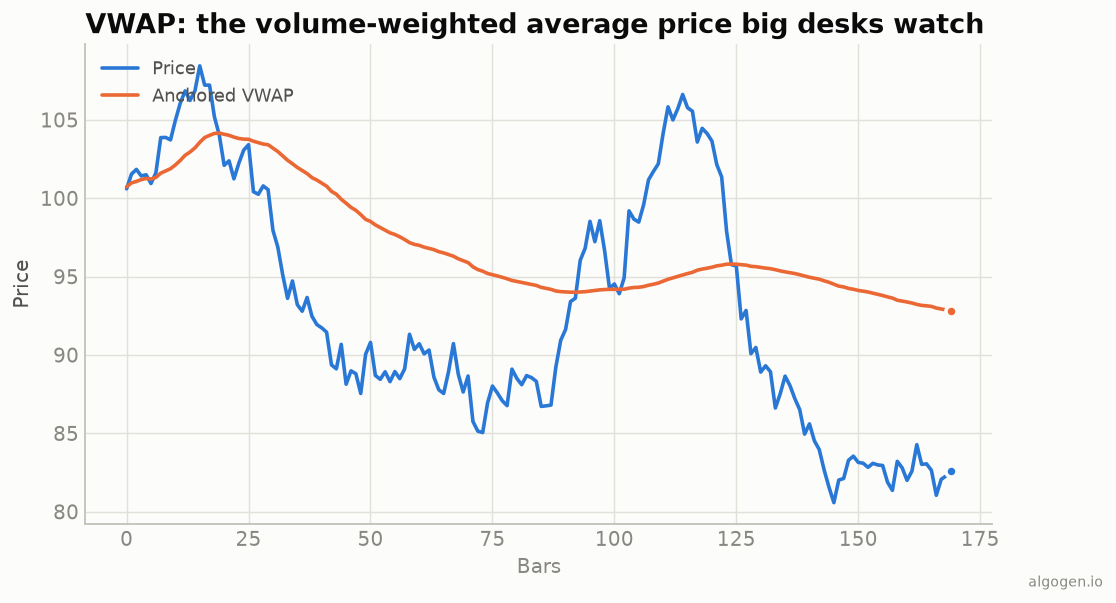
- Anchored VWAP (AVWAP) starts the accumulation from a point you choose — a major high, an earnings date, a swing low — and runs from there. It works on any timeframe and is what the chart above shows (anchored at the start), because a once-per-day reset doesn’t apply to a daily chart.
Same formula; different starting point and reset rule.
How to read it
Fair-value benchmark. Institutions judge execution against VWAP: buying below VWAP or selling above it means you beat the day’s average — a good fill. Whole algorithmic execution strategies exist just to trade at VWAP.
Bias line. Price above VWAP suggests buyers are in control for the session; below suggests sellers. Many intraday traders simply won’t be long below VWAP or short above it.
Mean reversion. Intraday, price often stretches away from VWAP and snaps back to it, so VWAP acts as a magnet and a dynamic support/resistance level.
VWAP bands. Adding standard-deviation bands around VWAP (like Bollinger Bands around a moving average) frames how far price has stretched from fair value.
Where it lies to you
- It’s fundamentally intraday. Session VWAP is meaningful within a day and resets; carrying it across days doesn’t make sense. On higher timeframes, use anchored VWAP instead.
- It “sets” as the day goes on. Early in a session VWAP is nimble; late in the day the accumulated volume is so large that new bars barely move it, so it becomes hard to shift — by design.
- It needs real volume. On instruments with poor or synthetic volume data, VWAP is unreliable. (Forex spot has no central volume, so exchange-VWAP is a futures/ equities concept.)
- It’s not predictive. VWAP describes where value traded; it doesn’t forecast where price goes next.
VWAP is less a “signal generator” than a reference level for fair value — but it’s one of the few indicators that genuinely reflects what large, price-sensitive players are doing, which is why it’s a fixture on professional screens.
Now go test it, don’t trust it
Does trading around VWAP — fading stretches, or only going with the above/below-VWAP bias — actually work on your instrument? Build it in AlgoGen and check. Then build VWAP yourself in Python, MQL5, Pine Script, EasyLanguage, or NinjaScript.
This post is educational, not financial advice. Indicators describe the past; they don’t predict the future. Backtest anything before you risk real money on it.
Sources and further reading
- The Total Cost of Transactions on the NYSE (The Journal of Finance)