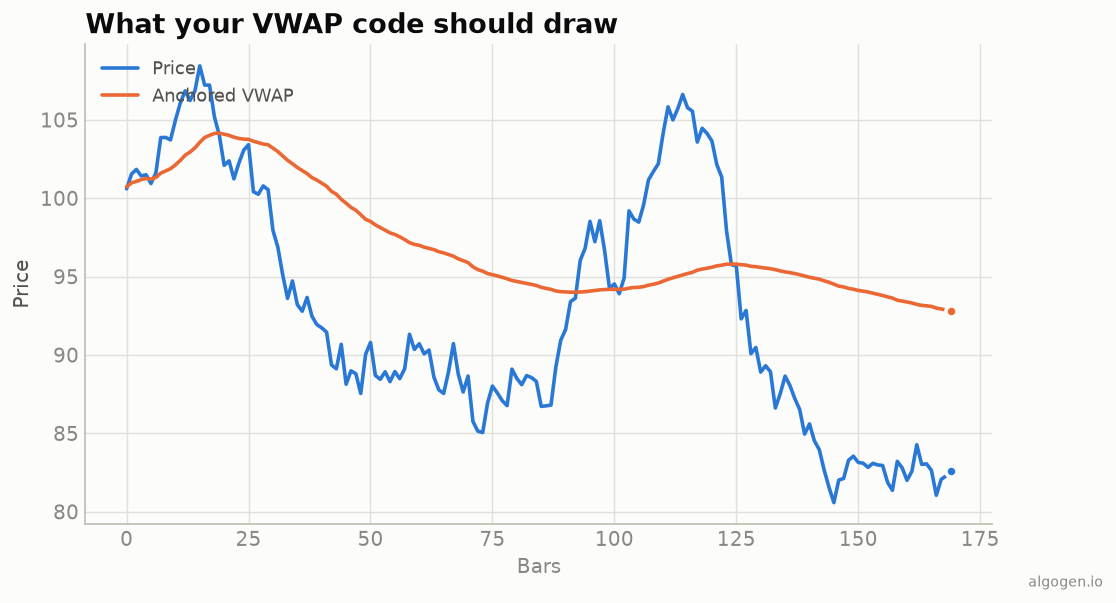
The essential mechanic for VWAP in EasyLanguage is detecting a new session and resetting the running sums. See the explainer for the concept; here’s a session VWAP for TradeStation and MultiCharts.
What you’ll need
- TradeStation or MultiCharts
- The EasyLanguage / PowerLanguage Editor, new Indicator
- An intraday chart
The source
{ AlgoGen Session VWAP — TradeStation / MultiCharts }
variables:
    Typical( 0 ),
    CumPV( 0 ),
    CumV( 0 ),
    VWAPval( 0 );

{ Reset the running sums at the first bar of each session }
if Date <> Date[1] then begin
    CumPV = 0;
    CumV  = 0;
end;

Typical = ( High + Low + Close ) / 3;
CumPV = CumPV + Typical * Volume;
CumV  = CumV + Volume;

if CumV > 0 then
    VWAPval = CumPV / CumV
else
    VWAPval = Typical;

Plot1( VWAPval, "VWAP" );
Date <> Date[1] is true on the first bar of a new day, which is where we zero the
accumulators. From there, each bar adds Typical × Volume and Volume to the
running sums, and VWAP is their ratio — overlaid on price like the output chart.
A VWAP bias strategy
The classic institutional-flavored use is refusing to fight VWAP — only taking longs above it:
{ AlgoGen VWAP Bias — Strategy (add to the study's VWAP calc) }
if Close > VWAPval and Close crosses over VWAPval then
    Buy next bar at market;
if Close < VWAPval then
    Sell next bar at market;
Reclaiming VWAP from below is the entry; losing it is the exit. On its own it’s crude, but as a filter on another signal (“only take longs while above VWAP”) it often earns its keep — the Strategy Performance Report will tell you.
Gotchas
Datechange = new session. In EasyLanguageDatereturns the bar’s date; comparing it toDate[1]cleanly detects the session boundary for the reset. For markets with overnight sessions, use the session-aware boundary that matches your data.- Intraday only. Session VWAP needs intraday bars; on daily data each session is a single bar and the line is meaningless.
VolumevsTicks. Make sure you’re feeding real volume (or knowingly using tick volume) — VWAP is only as good as the volume behind it.
Same indicator elsewhere: Python, MQL5, Pine Script, NinjaScript. Then backtest a VWAP rule in AlgoGen.
This post is educational, not financial advice. Indicators describe the past; they don’t predict the future. Backtest anything before you risk real money on it.
Sources and further reading
- The Total Cost of Transactions on the NYSE (The Journal of Finance)
- What is EasyLanguage? (TradeStation)