Almost every indicator in this series is decades old — born in the 1960s, 70s, or 80s. SuperTrend is the rare modern classic, and its story is a useful reminder that the indicator canon isn’t closed: a genuinely good, simple idea can still break through and go global, even in the 21st century.
A 2009 arrival
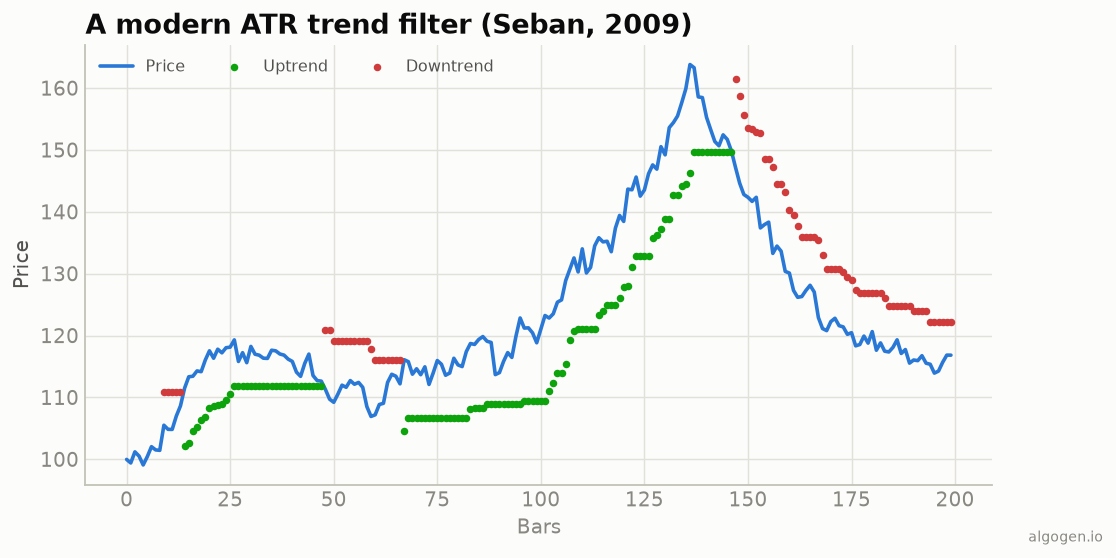
SuperTrend was introduced by Olivier Seban, a French trader and author, around 2009. That makes it a youngster next to Wilder’s 1978 toolkit or Granville’s 1963 OBV. Seban’s goal was refreshingly pragmatic: build a simple, volatility-aware trend filter that would work across any liquid market — forex, equities, futures, indices — and give a “straight talk” read on whether price was in an up- or down-trend relative to its own volatility.
Standing on Wilder’s shoulders
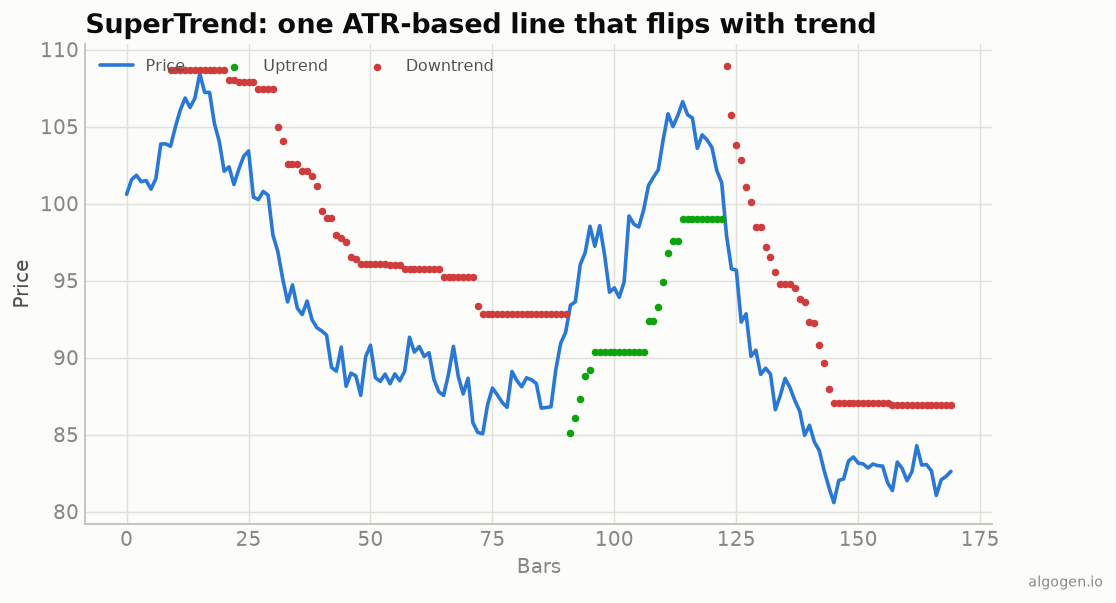
SuperTrend didn’t invent new mathematics; it recombined an old, proven one. Its entire engine is the Average True Range — J. Welles Wilder’s 1978 volatility measure (see the ATR history). Seban’s contribution was the framing: instead of using ATR for stops or position sizing (its traditional roles), he used it to build a pair of bands around the bar’s midpoint, added the band-locking logic so the line only ratchets in the trend’s favor, and reduced the whole thing to a single, colour-coded line that flips sides on a trend change.
That reduction is the genius of it. Traders already had ATR, already had trailing stops, already had trend filters — but SuperTrend packaged them into something a beginner could read at a glance and an algorithm could act on unambiguously.
Why it exploded when older tools didn’t need to
SuperTrend’s timing was perfect for the platform era. It arrived just as TradingView, retail algo platforms, and crypto trading were exploding, and it had exactly the qualities those communities love: a clean single line, a clear binary state (long or short), a trivially codeable formula, and a natural fit for automated strategies. It spread virally through Pine Script scripts, YouTube tutorials, and bot frameworks, becoming a default on essentially every modern charting platform within a decade — a speed of adoption the older classics achieved only over generations.
The trade-off it inherited
It’s worth being honest that SuperTrend inherited every weakness of the trend-following family it belongs to. Like the Parabolic SAR and Donchian breakouts, it is always in the market and gets whipsawed mercilessly in ranges. Its popularity sometimes outruns that caveat — a lot of newcomers meet SuperTrend first, assume its clean line means clean profits, and learn the hard way that a trend tool needs a trend. The math is modern; the lesson is as old as trading.
Variants and the community around it
Because SuperTrend arrived in the open-source-script era, it didn’t just spread — it mutated. Traders published countless variants: multi-timeframe SuperTrends (a fast one for entries, a slow one for the bigger trend), multiple SuperTrends stacked at different multipliers to grade trend strength, and hybrids that gate SuperTrend flips with an ADX or moving-average filter to tame the range-bound whipsaw. This remixability is itself a piece of the history: an indicator born on a scripting platform naturally becomes a template others build on, in a way the paper-and-pencil classics never could. The core, though, never changed — it’s still Wilder’s ATR wrapped in Seban’s flip logic.
Why it endured (fast)
SuperTrend earned its place because it does something real — frame price against its own volatility — in the most legible way yet devised, and because it landed in an era built to spread it. And, like everything in this series, there’s nothing to buy: an ATR, two bands, and a bit of flip logic. You can build Seban’s exact indicator in a few dozen lines, which is what we do in the implementation posts.
This post is educational, not financial advice. Indicators describe the past; they don’t predict the future. Backtest anything before you risk real money on it.