Some indicators are footnotes; the Donchian Channel is closer to a founding document. The man behind it is widely called the father of trend following, and the breakout idea it embodies runs straight through one of the most famous stories in all of trading — the Turtle experiment. For something that’s just “the highest high and lowest low,” it has an outsized legacy.
Richard Donchian, the father of trend following
Richard Donchian (1905–1993) developed his channel work in the mid-20th century, largely through the 1950s, while working as a commodities broker and fund manager. He’s credited with launching one of the first publicly-managed futures funds and with formalizing trend following as a disciplined, rule-based approach at a time when most trading was discretionary guesswork. He wrote a widely-followed market newsletter and championed the radical idea that you could define your buy and sell decisions with mechanical rules and simply follow them.
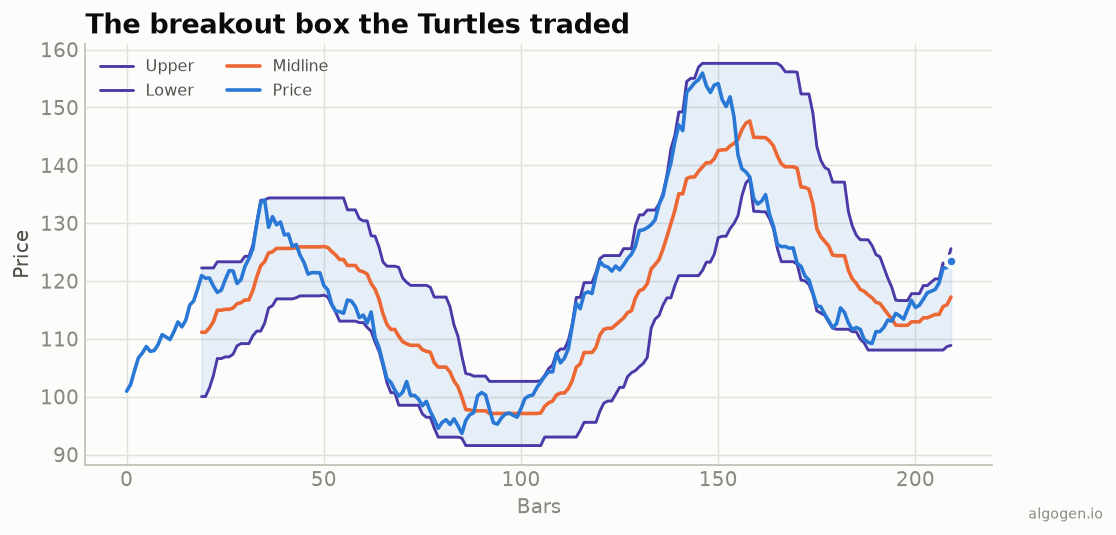
His most famous rule was the 4-week rule: buy when price makes a new four-week high, sell (and go short) when it makes a new four-week low. Strip away the packaging and that is a Donchian Channel breakout — roughly a 20-trading-day channel. It was breathtakingly simple and, crucially, completely mechanical: no opinions, no forecasts, just “follow price to new extremes.”
The Turtle experiment
The Donchian breakout’s place in legend was cemented decades later by the Turtle Traders. In the early 1980s, successful commodities trader Richard Dennis bet his partner William Eckhardt that trading could be taught — that he could take ordinary people with no experience and train them into profitable traders. They recruited a group (the “Turtles”), and the system they taught was, at its core, a Donchian-style breakout system: enter on breakouts of a 20-day (and 55-day) channel, size positions by volatility (ATR-based “N”), and exit on a shorter-channel breakout in the opposite direction.
The Turtles reportedly went on to make enormous collective profits, and the story became the canonical proof that systematic, rule-based trend following can work — and can be learned. At the heart of it sat Donchian’s highest-high/lowest-low idea, dressed in disciplined risk management.
Why it mattered more than it looked
It’s worth dwelling on how radical the simplicity was. In an era of tips and intuition, Donchian argued that a dumb, mechanical rule — buy new highs, sell new lows, and stick to it — could beat clever discretion, largely because it removed the emotion and forced you to ride the rare huge trends that make trend-following profitable. That philosophy, more than the specific channel, is his real legacy: it seeded modern managed futures, CTAs, and a big chunk of systematic trading. The SMA history in this series traces the same lineage from another angle.
Why it endured
The Donchian Channel survived because it’s the irreducible trend-following signal: you cannot make “buy a new high” simpler. It costs a rolling maximum and minimum, it plots cleanly, and it’s trivially backtestable — the perfect fit for the systematic era it helped launch. Every platform ships it, and every trend-following course eventually arrives back at it.
And, as always, there’s nothing to buy: two rolling extremes and their average. You can build Donchian’s exact breakout — the one the Turtles traded — in a couple of lines, which is what we do in the implementation posts.
This post is educational, not financial advice. Indicators describe the past; they don’t predict the future. Backtest anything before you risk real money on it.