Most posts in this series can name a person and a year. This one can’t, and that’s precisely the point. The Rate of Change has no single inventor because it’s not really an invention — it’s the most basic possible way to measure momentum, an idea so fundamental that it predates the notion of a named “indicator” entirely.
Momentum is older than technical analysis
The concept underneath ROC — comparing today’s price to an earlier price — is about as old as price records themselves. The moment someone wrote down a price on Tuesday and compared it to Monday’s, they were doing rate-of-change analysis. “Momentum” in the everyday sense (is this thing speeding up or slowing down?) is borrowed straight from physics, and applying it to prices required no genius, just subtraction. So while Wilder can claim the RSI and Lambert the CCI, nobody can really claim “price now minus price then.” It belongs to everybody.
Two flavors, one idea
What early technical analysts did do was formalize the idea into two standard tools that appear in essentially every charting package:
- The Momentum indicator: the raw difference,
close − close[n]. - The Rate of Change: the percentage version,
100 × (close − close[n]) / close[n].
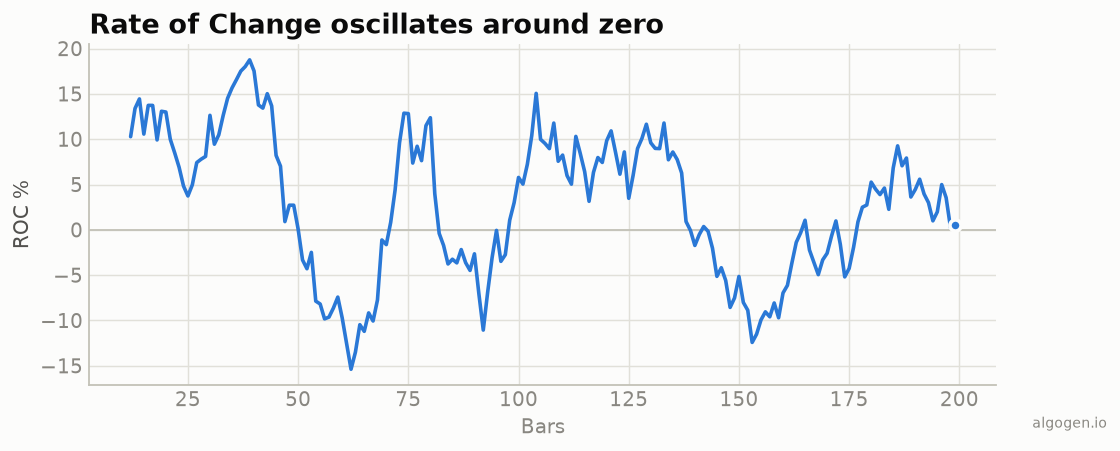
The percentage flavor (ROC) caught on because it’s comparable across instruments and price levels, but both are just “the change over a lookback.” They’ve been in the technical-analysis toolkit for so long, and are so obvious, that textbooks tend to present them as primitives rather than attribute them to anyone.
A word on “momentum” in academia
It’s worth separating two things that share a name. The ROC indicator is time-series momentum on a single instrument. Separately, academic finance has a well-documented cross-sectional momentum effect — the tendency of recently strong assets to keep outperforming recently weak ones — famously studied by Jegadeesh and Titman in a 1993 paper. That’s a different, statistical phenomenon about ranking many assets, not the ROC line on one chart, but both spring from the same intuition: recent performance carries information. The academic work gave “momentum” real empirical credibility; the ROC indicator is its humblest chart cousin.
The building block beneath everything
ROC’s real historical importance isn’t as a standalone signal — it’s as a component. Look under the hood of fancier indicators and you keep finding rate of change: the MACD is essentially a smoothed momentum of the difference between two averages; the TRIX is the rate of change of a triple-smoothed average; countless “custom” oscillators are ROC with a moving average stapled on. Understanding ROC means you’ve understood the DNA shared by a large chunk of the indicator universe.
The famous children of ROC
The clearest proof of ROC’s importance is the respected indicators built directly on top of it. The Coppock Curve, created by economist Edwin Coppock and introduced in Barron’s in 1962, is a long-term momentum gauge computed as a weighted moving average of the sum of two Rate-of-Change values (traditionally the 14-month and 11-month ROC) — a tool still watched for major stock-market bottoms. Martin Pring’s Know Sure Thing (KST) goes further, summing four smoothed ROCs of different lengths into a single “summed rate of change” oscillator. Both are, at heart, ROC with weighting and smoothing on top — living evidence that this humble one-line primitive is a foundation serious analysts kept building on decades after it became standard.
Why it endured
The Rate of Change endured for the most fundamental reason possible: it measures something real (speed of price change), it’s impossible to make simpler, and it costs one subtraction and one division. There was never anything to sell, patent, or brand — which is exactly why it quietly became a primitive that everything else is built from. You can implement it in literally one line, which is what we do in the implementation posts.
This post is educational, not financial advice. Indicators describe the past; they don’t predict the future. Backtest anything before you risk real money on it.