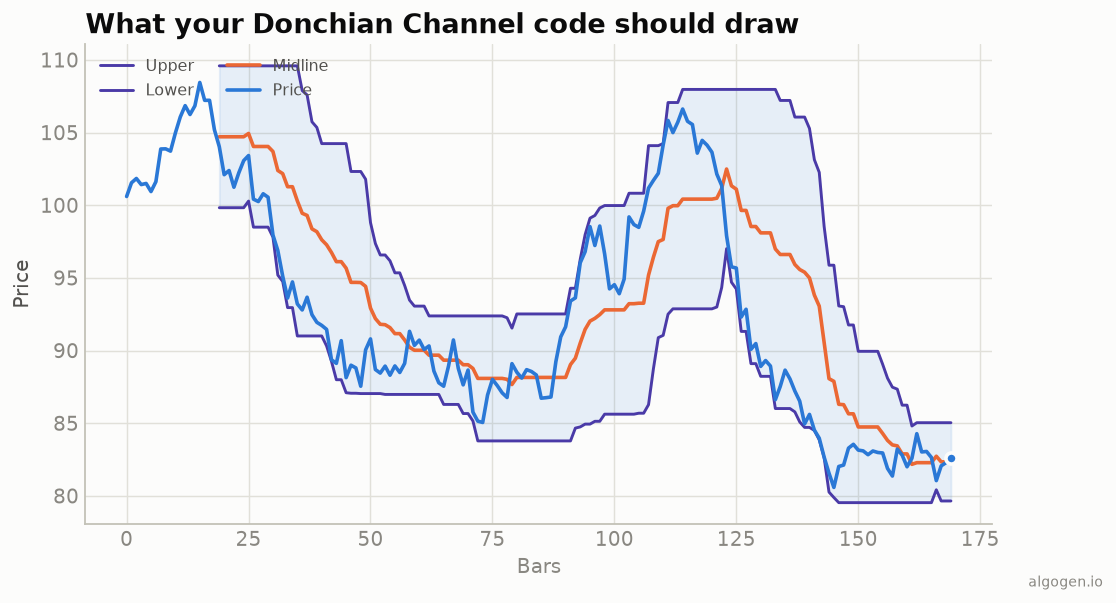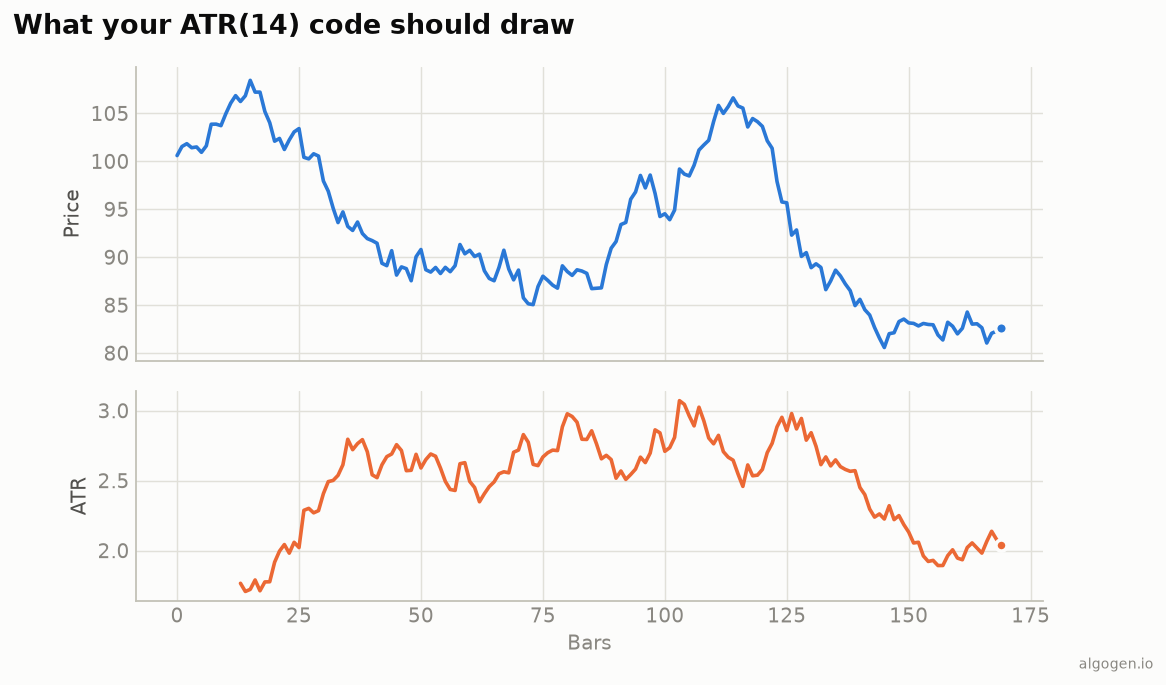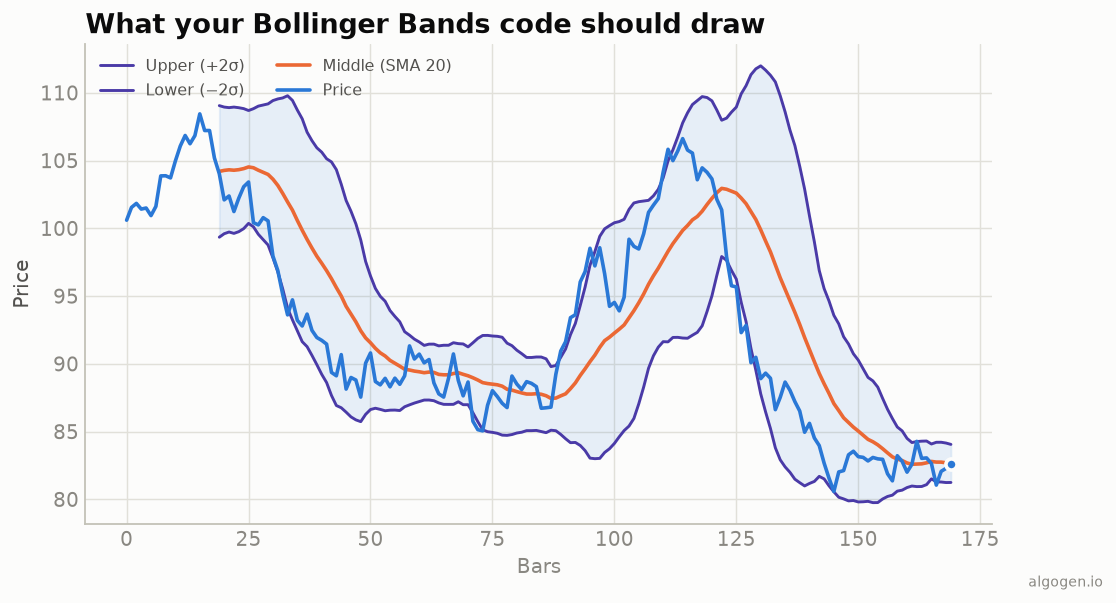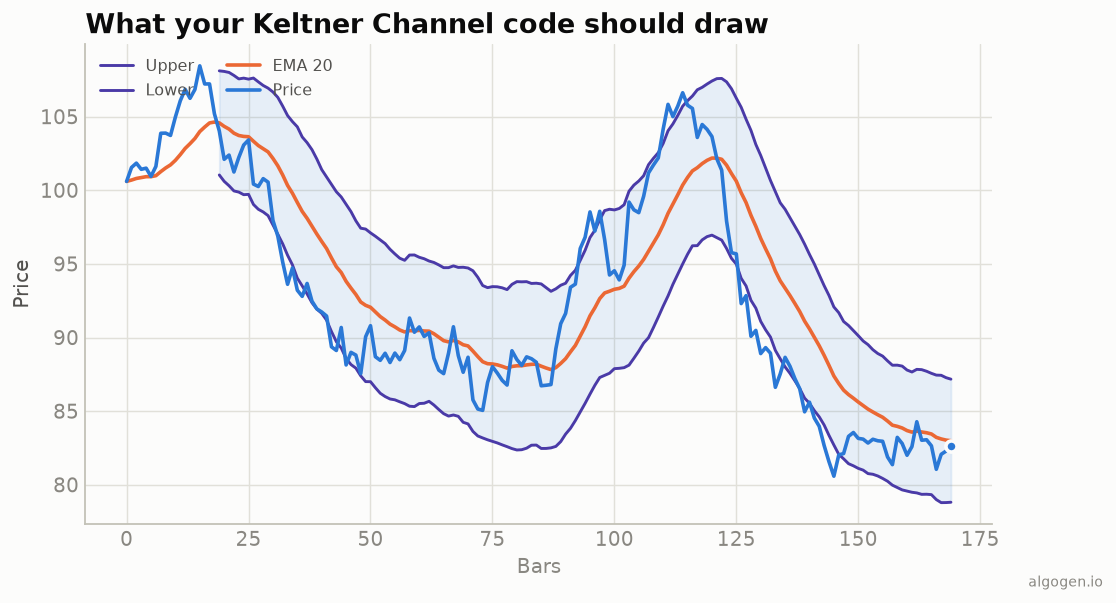
We previously published an MT4 Keltner Channel; here’s the modern MQL5 version, using MT5’s built-in indicator handles for the EMA and ATR so the code stays short and correct. See the explainer for the concept.
What you’ll need
- MetaTrader 5 with MetaEditor
- Save as
AlgoGen.Keltner.mq5underMQL5/Indicators/
The source
//+------------------------------------------------------------------+
//|                                              AlgoGen.Keltner.mq5 |
//|                                          Copyright 2026, AlgoGen |
//|                                           https://www.algogen.io |
//+------------------------------------------------------------------+
#property copyright "Copyright 2026, AlgoGen"
#property link      "https://www.algogen.io"
#property version   "1.00"
#property indicator_chart_window
#property indicator_buffers 3
#property indicator_plots   3

#property indicator_label1  "Middle"
#property indicator_type1   DRAW_LINE
#property indicator_color1  clrOrangeRed
#property indicator_width1  2
#property indicator_label2  "Upper"
#property indicator_type2   DRAW_LINE
#property indicator_color2  clrMediumPurple
#property indicator_label3  "Lower"
#property indicator_type3   DRAW_LINE
#property indicator_color3  clrMediumPurple

input int    InpEmaPeriod = 20;
input int    InpAtrPeriod = 10;
input double InpMult       = 2.0;

double MidBuffer[], UpBuffer[], LoBuffer[];
int    emaHandle, atrHandle;

int OnInit()
  {
   SetIndexBuffer(0, MidBuffer, INDICATOR_DATA);
   SetIndexBuffer(1, UpBuffer,  INDICATOR_DATA);
   SetIndexBuffer(2, LoBuffer,  INDICATOR_DATA);
   emaHandle = iMA(_Symbol, _Period, InpEmaPeriod, 0, MODE_EMA, PRICE_CLOSE);
   atrHandle = iATR(_Symbol, _Period, InpAtrPeriod);
   if(emaHandle == INVALID_HANDLE || atrHandle == INVALID_HANDLE)
      return(INIT_FAILED);
   IndicatorSetString(INDICATOR_SHORTNAME, "AlgoGen Keltner");
   return(INIT_SUCCEEDED);
  }

int OnCalculate(const int rates_total, const int prev_calculated,
                const datetime &time[], const double &open[],
                const double &high[],   const double &low[],
                const double &close[],  const long &tick_volume[],
                const long &volume[],   const int &spread[])
  {
   int need = MathMax(InpEmaPeriod, InpAtrPeriod);
   if(rates_total < need) return(0);

   double ema[], atr[];
   if(CopyBuffer(emaHandle, 0, 0, rates_total, ema) <= 0) return(prev_calculated);
   if(CopyBuffer(atrHandle, 0, 0, rates_total, atr) <= 0) return(prev_calculated);

   int start = (prev_calculated > 0) ? prev_calculated - 1 : need;
   for(int i = start; i < rates_total; i++)
     {
      MidBuffer[i] = ema[i];
      UpBuffer[i]  = ema[i] + InpMult * atr[i];
      LoBuffer[i]  = ema[i] - InpMult * atr[i];
     }
   return(rates_total);
  }
//+------------------------------------------------------------------+
Install & compile
- Drop it in
MQL5/Indicators/, press F7. - Drag onto a chart — three lines overlay price, matching the output chart.
Gotchas
- Handles +
CopyBuffer. ReusingiMA(MODE_EMA)andiATRguarantees your EMA and ATR match MT5’s own, so your channel is standard. Copying full arrays each pass is simple; cache for performance in production. - EMA vs SMA centerline.
MODE_EMAgives the modern Keltner; the 1960 original used an SMA of typical price with a range-based band — a different indicator. - MT4 version. Our earlier MT4 post computes the bands with an EMA/ATR directly in MQL4; the math is the same, only the API differs.
Same indicator elsewhere: Python, Pine Script, EasyLanguage, NinjaScript. Then test a Keltner breakout in AlgoGen.
This post is educational, not financial advice. Indicators describe the past; they don’t predict the future. Backtest anything before you risk real money on it.
Sources and further reading
- Technical indicator functions (MetaQuotes)