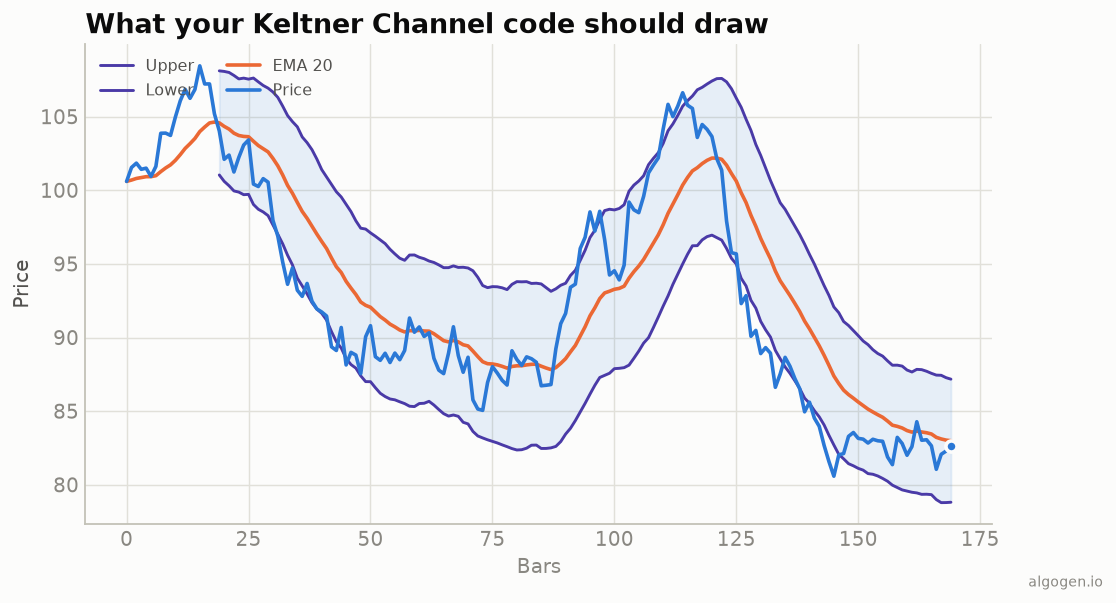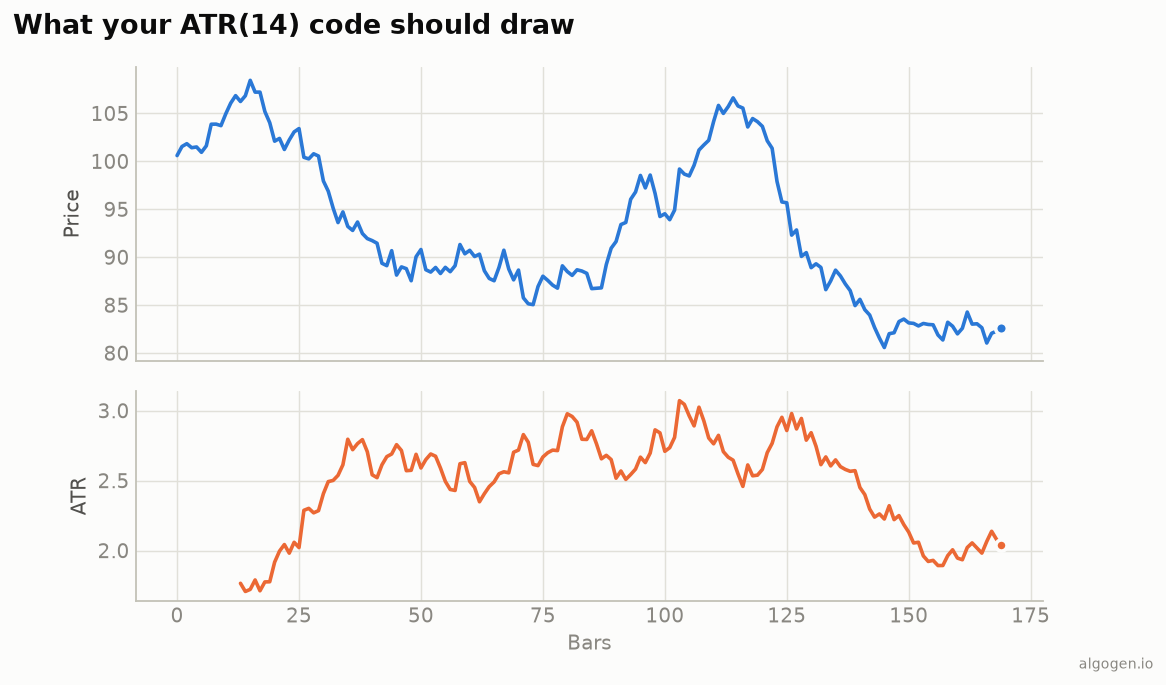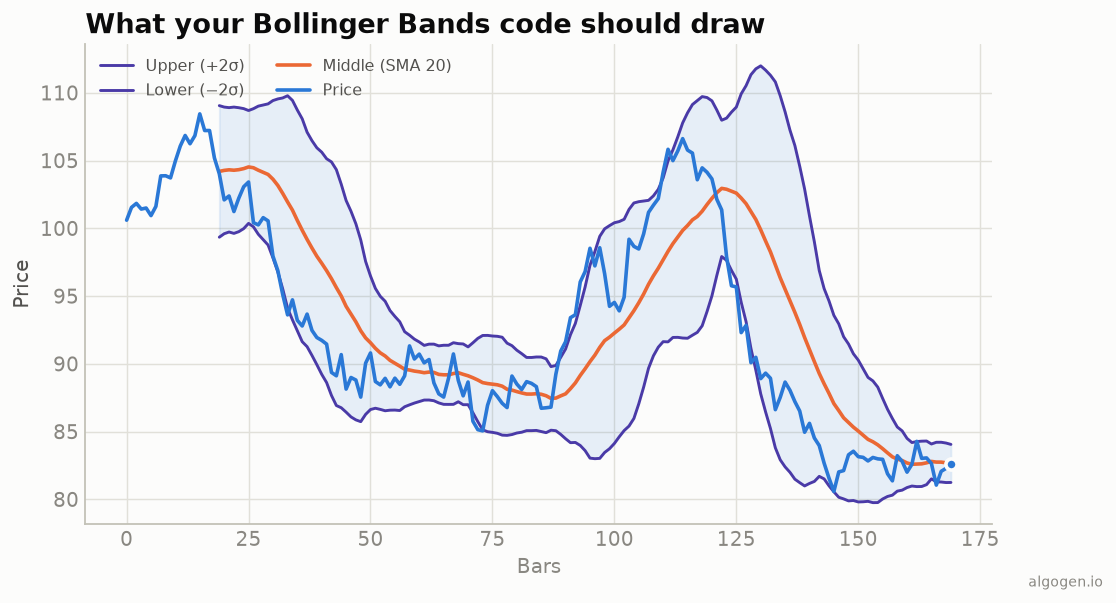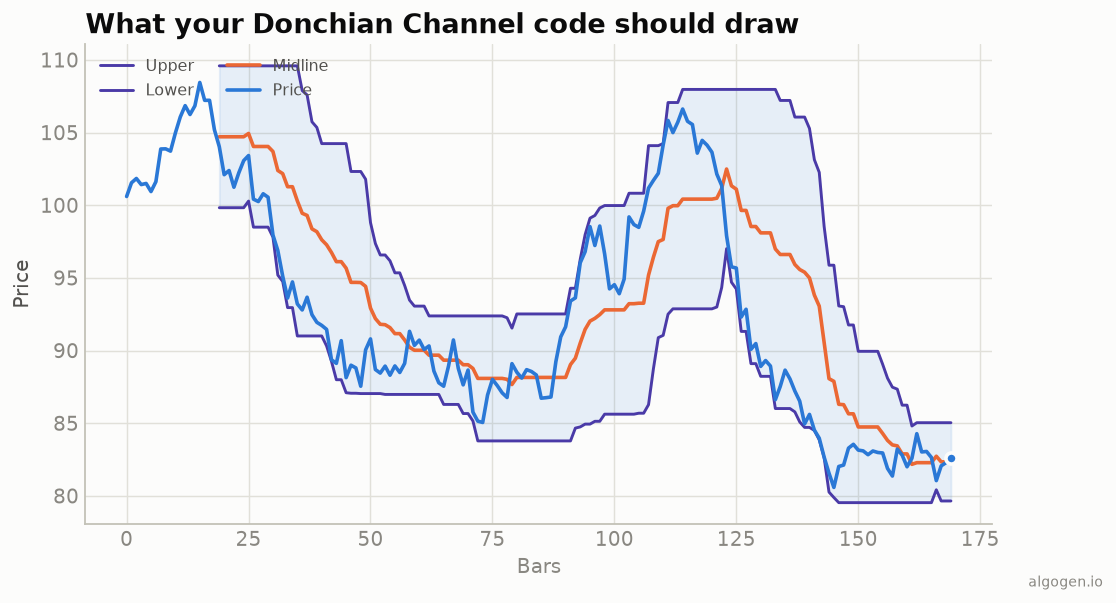
Donchian Channels aren’t a default MT5 indicator, so this is a useful one to own. The math is a rolling high/low; the subtlety is the breakout shift (see the explainer).
What you’ll need
- MetaTrader 5 with MetaEditor
- Save as
AlgoGen.Donchian.mq5underMQL5/Indicators/
The source
//+------------------------------------------------------------------+
//|                                             AlgoGen.Donchian.mq5 |
//|                                          Copyright 2026, AlgoGen |
//|                                           https://www.algogen.io |
//+------------------------------------------------------------------+
#property copyright "Copyright 2026, AlgoGen"
#property link      "https://www.algogen.io"
#property version   "1.00"
#property indicator_chart_window
#property indicator_buffers 3
#property indicator_plots   3

#property indicator_label1  "Upper"
#property indicator_type1   DRAW_LINE
#property indicator_color1  clrMediumPurple
#property indicator_label2  "Middle"
#property indicator_type2   DRAW_LINE
#property indicator_color2  clrOrangeRed
#property indicator_label3  "Lower"
#property indicator_type3   DRAW_LINE
#property indicator_color3  clrMediumPurple

input int InpPeriod = 20;

double UpBuffer[], MidBuffer[], LoBuffer[];

int OnInit()
  {
   SetIndexBuffer(0, UpBuffer,  INDICATOR_DATA);
   SetIndexBuffer(1, MidBuffer, INDICATOR_DATA);
   SetIndexBuffer(2, LoBuffer,  INDICATOR_DATA);
   for(int p = 0; p < 3; p++)
      PlotIndexSetInteger(p, PLOT_DRAW_BEGIN, InpPeriod - 1);
   IndicatorSetString(INDICATOR_SHORTNAME, "AlgoGen Donchian(" + (string)InpPeriod + ")");
   return(INIT_SUCCEEDED);
  }

int OnCalculate(const int rates_total, const int prev_calculated,
                const datetime &time[], const double &open[],
                const double &high[],   const double &low[],
                const double &close[],  const long &tick_volume[],
                const long &volume[],   const int &spread[])
  {
   if(rates_total < InpPeriod) return(0);

   int start = (prev_calculated > InpPeriod) ? prev_calculated - 1 : InpPeriod - 1;
   for(int i = start; i < rates_total; i++)
     {
      double hh = high[i], ll = low[i];
      for(int j = 1; j < InpPeriod; j++)
        {
         if(high[i - j] > hh) hh = high[i - j];
         if(low[i - j]  < ll) ll = low[i - j];
        }
      UpBuffer[i]  = hh;
      LoBuffer[i]  = ll;
      MidBuffer[i] = (hh + ll) / 2.0;
     }
   return(rates_total);
  }
//+------------------------------------------------------------------+
Install & compile
- Drop it in
MQL5/Indicators/, press F7. - Drag onto a chart — the stepped upper/lower/mid channel overlays price, matching the output chart.
Gotchas
- Prior-bar breakout in an EA. For a signal, compare the current close to
UpBuffer[i-1]/LoBuffer[i-1](the channel excluding the current bar). UsingUpBuffer[i]would include today’s own high and never trigger. - Built-in high/low. You can also use
iHighest/iLowestinstead of the inner loop; the loop is shown for clarity. - MQL4. Same math; swap the
OnCalculatesignature and buffer setup, or useiHighest/iLowest.
Same indicator elsewhere: Python, Pine Script, EasyLanguage, NinjaScript. Then test a Donchian breakout in AlgoGen.
This post is educational, not financial advice. Indicators describe the past; they don’t predict the future. Backtest anything before you risk real money on it.
Sources and further reading
- Technical indicator functions (MetaQuotes)