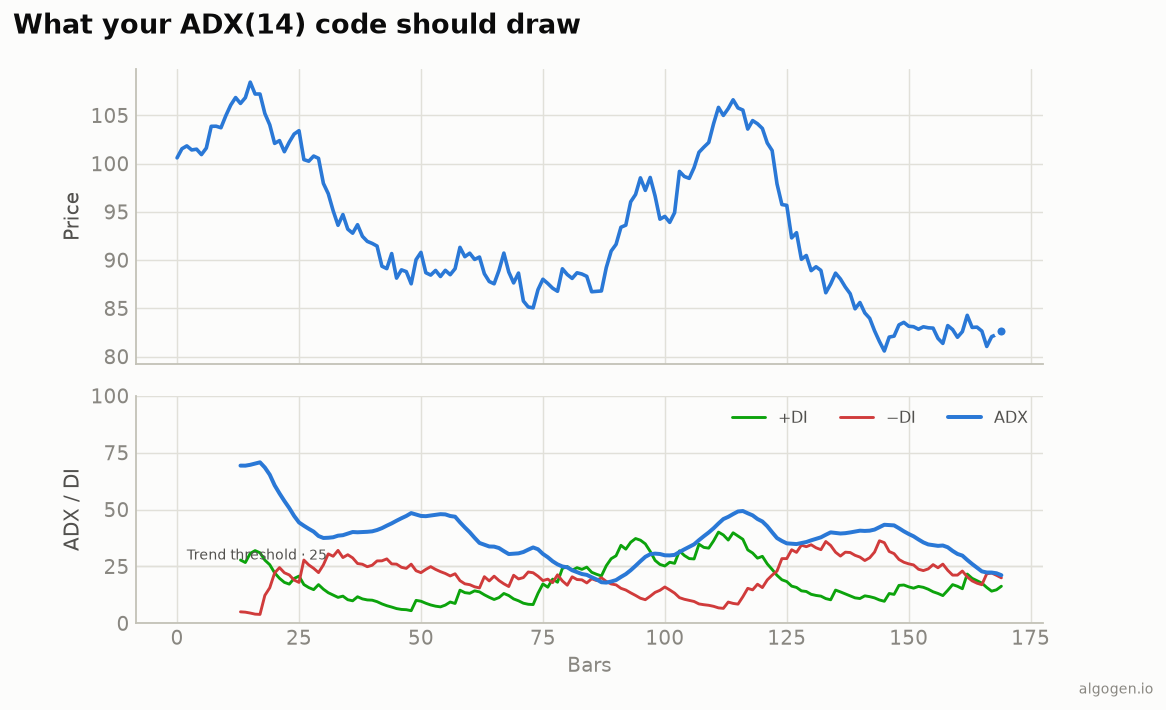
EasyLanguage ships the whole directional system as reserved words, which is a relief given how many steps the ADX has (see the explainer). Here’s the study and an ADX-filtered strategy.
What you’ll need
- TradeStation or MultiCharts
- The EasyLanguage / PowerLanguage Editor, new Indicator
The source
{ AlgoGen ADX — TradeStation / MultiCharts }
inputs:
    Length( 14 ),
    TrendLevel( 25 );

variables:
    ADXval( 0 ), PlusDI( 0 ), MinusDI( 0 );

ADXval  = ADX( Length );
PlusDI  = DMIPlus( Length );
MinusDI = DMIMinus( Length );

Plot1( ADXval,  "ADX" );
Plot2( PlusDI,  "+DI" );
Plot3( MinusDI, "−DI" );
Plot4( TrendLevel, "Trend" );
ADX( Length ) gives the trend-strength line, and DMIPlus/DMIMinus give the
directional lines — the three series in the output chart. (Some EasyLanguage
versions also expose DMI and ADXR.)
An ADX-filtered strategy
The most valuable use is filtering, not raw DI crosses:
{ AlgoGen ADX Trend Filter — Strategy }
inputs: Length( 14 ), TrendLevel( 25 );
variables: ADXval( 0 ), PlusDI( 0 ), MinusDI( 0 );

ADXval  = ADX( Length );
PlusDI  = DMIPlus( Length );
MinusDI = DMIMinus( Length );

{ Only act on a DI cross when a trend actually exists }
if ADXval > TrendLevel then begin
    if PlusDI crosses over MinusDI then Buy next bar at market;
    if MinusDI crosses over PlusDI then SellShort next bar at market;
end;
The Strategy Performance Report will show whether gating DI crosses on ADX > TrendLevel beats trading every cross.
ADXR and RadarScreen
For ranking a watchlist by trend strength, ADXR( Length ) — Wilder’s smoothed
rating — makes a steadier column than raw ADX in RadarScreen or the scanner:
Plot5( ADXR( Length ), "ADXR" );
Sort a RadarScreen by ADXR to surface the markets with the most established trends, then apply your directional logic only to those — a direct nod to how Wilder intended the Directional Movement System to be used for market selection, not just timing.
Gotchas
- Reserved-word availability.
ADX,DMIPlus, andDMIMinusare standard, but older or third-party EasyLanguage dialects vary — check your platform’s function list if one won’t verify. - Lag. ADX is double-smoothed and late; use it to confirm the environment, not to time entries precisely.
- Direction vs strength.
ADXis strength only; you must readDMIPlusversusDMIMinusto know which way.
Same indicator elsewhere: Python, MQL5, Pine Script, NinjaScript. Then backtest an ADX filter in AlgoGen.
This post is educational, not financial advice. Indicators describe the past; they don’t predict the future. Backtest anything before you risk real money on it.
Sources and further reading
- What is EasyLanguage? (TradeStation)