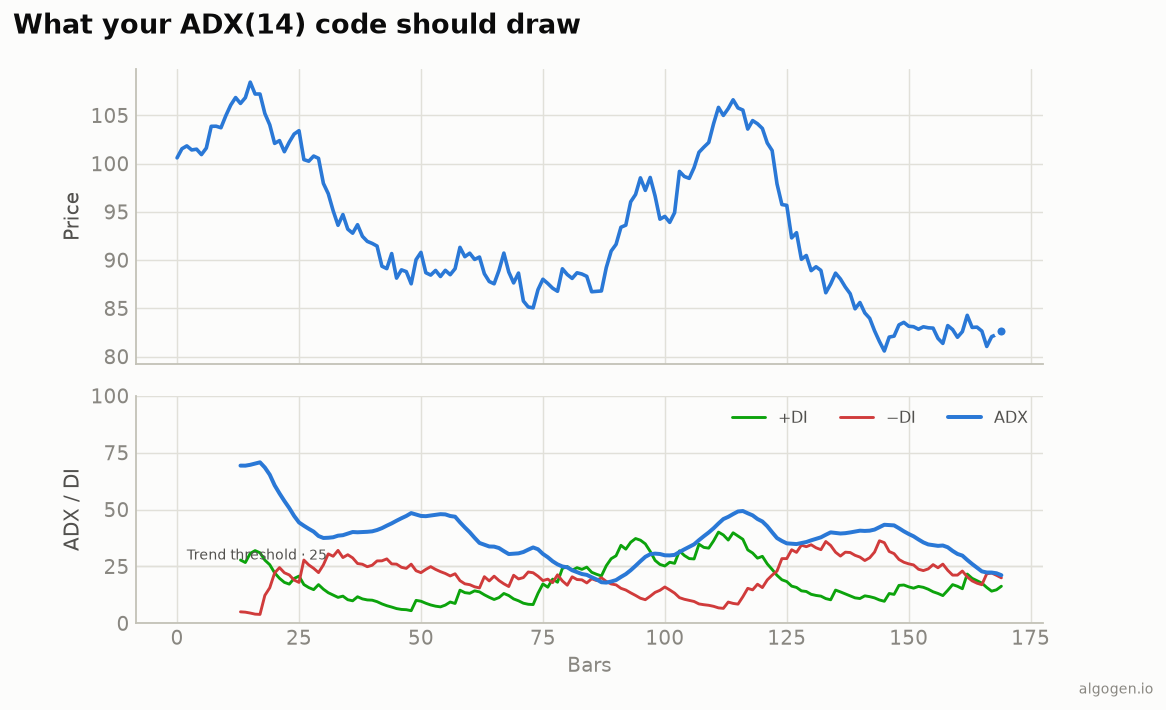
The ADX is a multi-stage calculation (see the explainer),
and MT5’s built-in iADX implements it correctly, so the pragmatic MQL5 approach
is to read the handle rather than re-derive the whole chain by hand. That gives you
ADX, +DI and −DI ready for an Expert Advisor.
What you’ll need
- MetaTrader 5 with MetaEditor
Reading iADX in an EA
//+------------------------------------------------------------------+
//| AlgoGen ADX reader — for use inside an Expert Advisor            |
//+------------------------------------------------------------------+
input int InpPeriod = 14;
input double InpTrendLevel = 25.0;

int adxHandle;

int OnInit()
  {
   adxHandle = iADX(_Symbol, _Period, InpPeriod);
   if(adxHandle == INVALID_HANDLE)
      return(INIT_FAILED);
   return(INIT_SUCCEEDED);
  }

// iADX buffers: 0 = ADX (MAIN), 1 = +DI (PLUSDI), 2 = -DI (MINUSDI)
bool ReadADX(double &adx, double &plusDI, double &minusDI)
  {
   double a[], p[], m[];
   if(CopyBuffer(adxHandle, 0, 0, 2, a) < 2) return(false);
   if(CopyBuffer(adxHandle, 1, 0, 2, p) < 2) return(false);
   if(CopyBuffer(adxHandle, 2, 0, 2, m) < 2) return(false);
   adx = a[1]; plusDI = p[1]; minusDI = m[1];   // [1] = last closed bar
   return(true);
  }

// Example regime filter: only signal a long when a real up-trend exists.
bool StrongUptrend()
  {
   double adx, p, m;
   if(!ReadADX(adx, p, m)) return(false);
   return(adx > InpTrendLevel && p > m);
  }
The handle-and-CopyBuffer pattern is the standard MT5 way to consume an
indicator in an EA. Buffer 0 is the ADX itself; buffers 1 and 2 are the +DI/−DI
direction lines shown in the output chart.
The math behind the buffers
If you ever need to build it yourself (say, for a non-standard smoothing), the
chain is: compute +DM/−DM (only the larger, positive directional move counts),
Wilder-smooth them and the ATR, form +DI = 100·smoothed(+DM)/ATR
and likewise −DI, then DX = 100·|+DI−−DI|/(+DI+−DI), and finally Wilder-smooth DX
into ADX. It’s four Wilder-smoothed series and two ratios — correct but fiddly,
which is exactly why iADX is the sensible default.
Gotchas
- Buffer order.
iADXis ADX(0), +DI(1), −DI(2). Reading them in the wrong order silently swaps strength and direction. - Use
[1], not[0]. Read the last closed bar for stable signals; bar[0]is still forming. - MQL4.
iADXexists there too, using mode constants (MODE_MAIN,MODE_PLUSDI,MODE_MINUSDI).
Same indicator elsewhere: Python, Pine Script, EasyLanguage, NinjaScript. Then test an ADX filter in AlgoGen.
This post is educational, not financial advice. Indicators describe the past; they don’t predict the future. Backtest anything before you risk real money on it.
Sources and further reading
- Technical indicator functions (MetaQuotes)