If Larry Williams’ name sounds familiar, it should — he already appears in this series for Williams %R. The Ultimate Oscillator is his more ambitious creation, and it’s unusual among indicators in that it was built to solve a specific, named flaw in the tools that came before it.
The problem Williams set out to fix
By the mid-1970s, momentum oscillators like his own %R and the emerging RSI were popular, but they shared an annoying weakness. A single-period oscillator is tuned to one timeframe, and that makes it prone to premature divergence: at the start of a strong move, the oscillator spikes to an extreme, and then as the move continues it “diverges” from price — flashing a reversal signal that never comes, over and over, while the trend rolls on. Traders who faded those divergences got run over.
Williams’ diagnosis was precise: the problem is committing to one timeframe. A short lookback is responsive but noisy and diverges early; a long one is smoother but sluggish. Why not blend several?
The 1976 solution
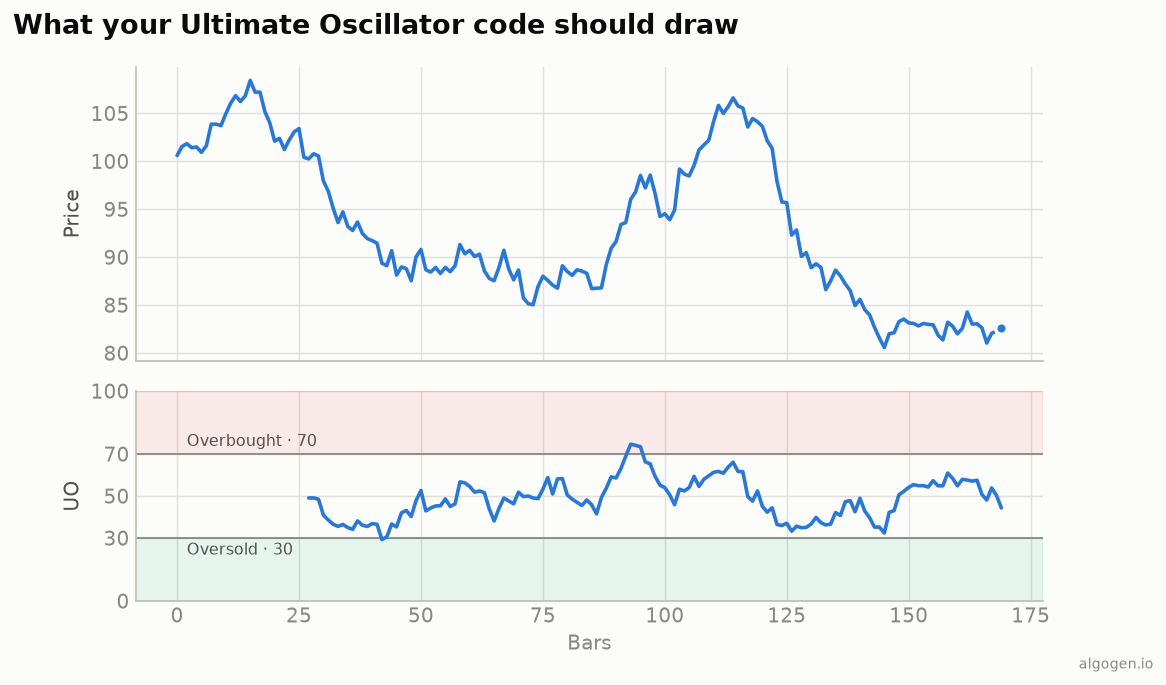
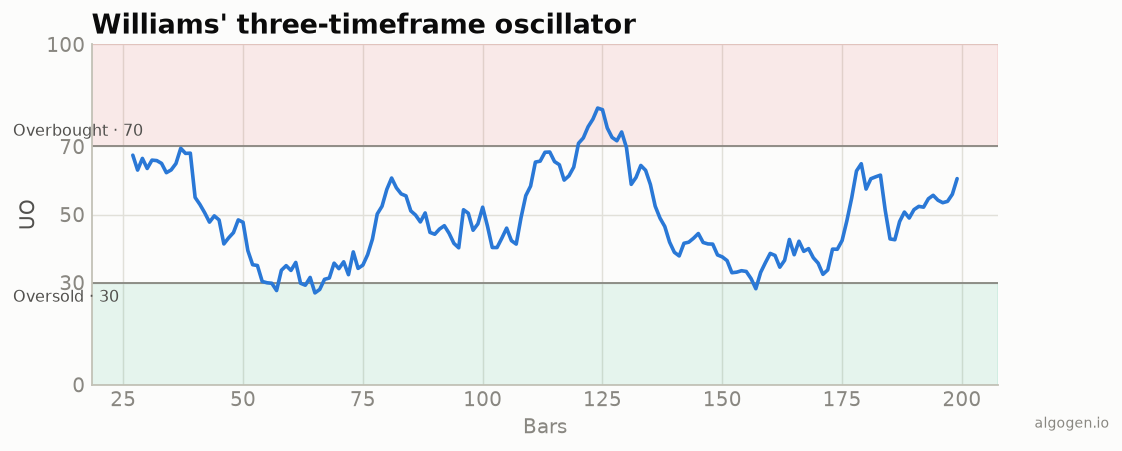
In 1976, Williams built the Ultimate Oscillator to do exactly that. It measures “buying pressure” relative to true range over three timeframes — short, medium, and long (7, 14, and 28 periods) — and combines them into a single 0–100 line, weighting the fastest most heavily. The reasoning: a signal that shows up across all three horizons is far more trustworthy than one that only appears on the jumpy short one. By requiring multi-timeframe agreement, the Ultimate Oscillator aims to filter out the false divergences that plagued its single-period predecessors. It was later featured in Technical Analysis of Stocks & Commodities in 1985, which spread it widely.
A precise signal, not a vibe
One thing that sets the Ultimate Oscillator apart historically is that Williams didn’t just publish a line — he published a specific, multi-condition trading rule. His divergence signal requires the oscillator’s divergence to occur from an extreme (below 30 for buys), the divergence itself, and a breakout past the divergence’s high. That rigor is unusual; most oscillators are handed to traders as “above 70 sell, below 30 buy” and left there. Williams tried to define exactly what counted as a valid signal, which is very much in keeping with the disciplined, testable approach he championed throughout his career (see also his Commitment of Traders work).
Why it endured
The Ultimate Oscillator never became as ubiquitous as the RSI, but it earned a durable place because it addresses a real problem thoughtfully, and because Williams’ name and track record carried weight. Multi-timeframe thinking — the core idea here — has only grown more central to trading over the decades, making the Ultimate Oscillator feel, in retrospect, ahead of its time.
And, as ever, there’s nothing to buy: buying pressure, true range, three summed ratios, and a weighted blend. You can build Williams’ 1976 indicator in a dozen lines, which is what we do in the implementation posts.
This post is educational, not financial advice. Indicators describe the past; they don’t predict the future. Backtest anything before you risk real money on it.