TRIX has one of the most precisely-dated origins in this series — a specific magazine, a specific issue, and a specific, slightly punny article title. It’s also a neat example of an indicator whose very existence depended on a piece of technology arriving on traders’ desks: the personal computer.
A 1983 magazine debut
TRIX was introduced by Jack K. Hutson, the founder and long-time publisher of Technical Analysis of Stocks & Commodities magazine — for decades the premier journal of the indicator-building world. He presented TRIX in the July 1983 issue, in an article memorably titled “Good Trix.” The name is a double play: it’s both “TRiple EXponential” and a wink at the breakfast-cereal slogan.
Hutson’s magazine deserves a mention of its own here, because it’s the birthplace or proving ground of a remarkable number of tools in this series — its “Traders’ Tips” and feature articles were where analysts published and refined indicators for a technical, computer-literate audience. TRIX is one of its signature home-grown contributions.
Why it needed computers
Here’s the historical hook. Computing an EMA by hand is tedious; computing an EMA of an EMA of an EMA by hand is genuinely impractical for a working trader. TRIX’s triple-smoothing only became a realistic everyday tool once personal computers arrived to do the arithmetic instantly — which is exactly the moment, the early 1980s, when Hutson introduced it. TRIX is a product of that transition: an indicator that would have been absurd to maintain with paper and a calculator, made trivial by a machine on the desk. Several indicators of that era share this DNA; they’re “computer-native” in a way the hand-drawn tools of Dow’s day never were.
The idea: smooth hard, then measure momentum
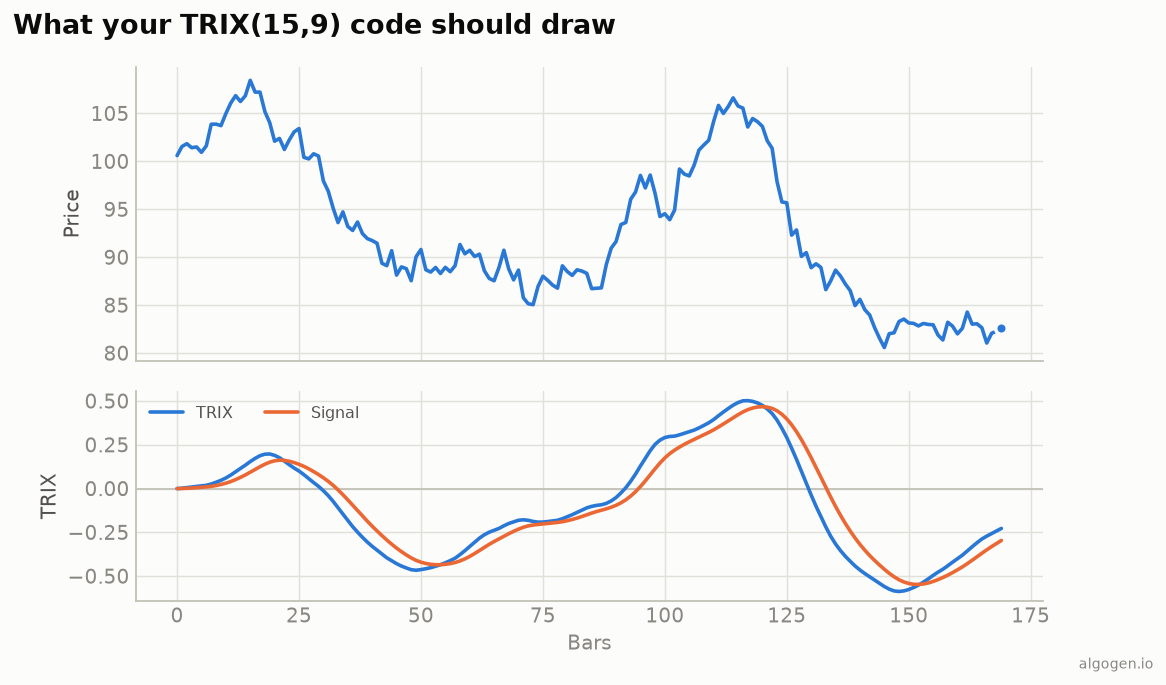
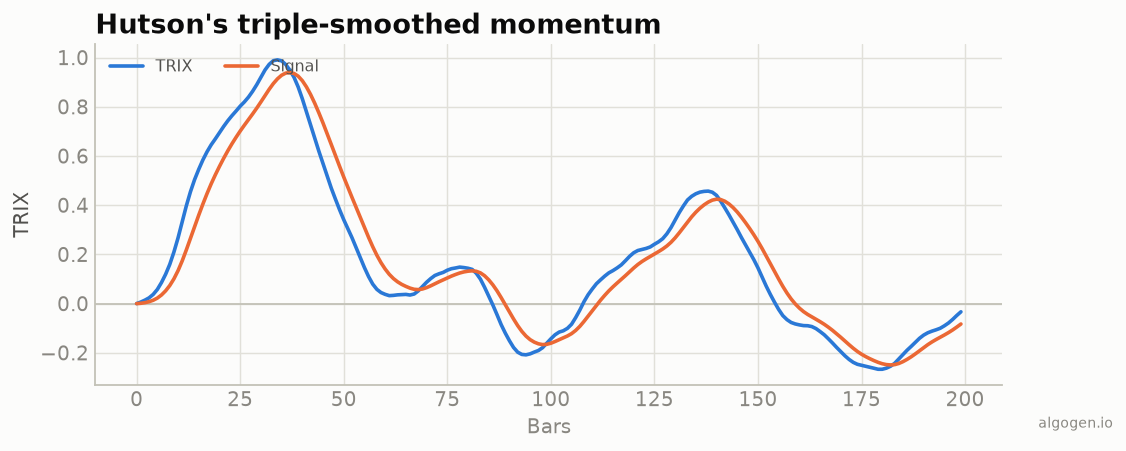
Hutson’s goal was noise reduction. Momentum oscillators are useful but jumpy, and he wanted a version that responded only to significant trend changes, not every minor wiggle. Three successive exponential smoothings scrub out the short cycles; taking the rate of change of that ultra-smooth line then gives a momentum reading with far fewer false signals. It’s philosophically similar to the MACD (a difference of smoothed averages) but pushes the smoothing further, trading responsiveness for cleanliness.
Don’t confuse TRIX with TEMA
A frequent source of confusion is worth clearing up, because the names collide. TRIX (Hutson, 1983) is an oscillator: the rate of change of a triple-smoothed EMA, plotted around zero. TEMA — the Triple Exponential Moving Average, devised by Patrick Mulloy in 1994 (see the EMA history) — is an overlay: a faster, lower-lag moving average laid on price. Both involve “triple exponential” smoothing, but they do opposite jobs: TRIX measures momentum in its own panel, TEMA rides price to reduce lag. If someone says “the triple exponential indicator,” ask which one they mean. It’s a tidy example of how the technical- analysis vocabulary, grown piecemeal over decades, ends up with near-identical names for unrelated tools.
Why it endured
TRIX endured because it fills a specific niche cleanly: a low-noise momentum oscillator with a familiar line/signal/zero-cross interface. Traders who found faster oscillators too whippy adopted it, it plotted neatly in its own pane, and — being a stack of EMAs and a rate of change — it was trivial for the very software that made it practical to include as a standard study.
And, as always in this series, there’s nothing proprietary: three EMAs and a percentage change. You can build Hutson’s exact 1983 indicator in a few lines, which is what we do in the implementation posts.
This post is educational, not financial advice. Indicators describe the past; they don’t predict the future. Backtest anything before you risk real money on it.