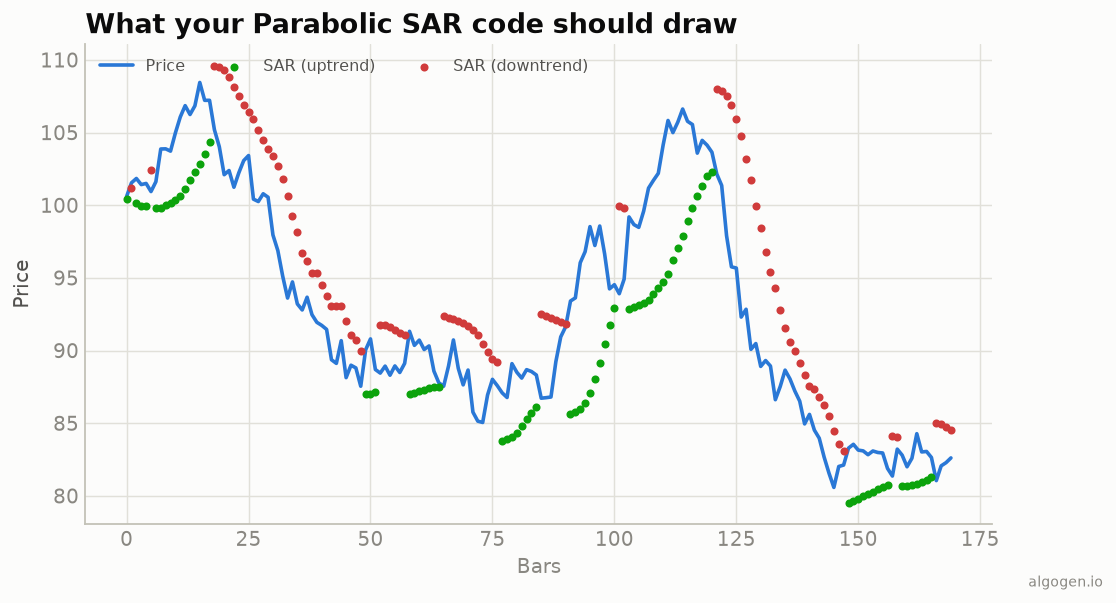
The Parabolic SAR’s recursive flip logic is fiddly to get exactly right (see
the explainer), and MT5’s built-in iSAR
implements it correctly — so for MQL5 the sensible path is to read the handle and
use it, especially as a trailing stop in an Expert Advisor.
What you’ll need
- MetaTrader 5 with MetaEditor
Reading iSAR in an EA
//+------------------------------------------------------------------+
//| AlgoGen Parabolic SAR reader — for use inside an EA              |
//+------------------------------------------------------------------+
input double InpStep = 0.02;   // acceleration step
input double InpMax  = 0.20;   // acceleration maximum

int sarHandle;

int OnInit()
  {
   sarHandle = iSAR(_Symbol, _Period, InpStep, InpMax);
   if(sarHandle == INVALID_HANDLE)
      return(INIT_FAILED);
   return(INIT_SUCCEEDED);
  }

// Read the last two SAR values and detect a flip vs price.
bool ReadSAR(double &sarNow, double &sarPrev)
  {
   double s[];
   if(CopyBuffer(sarHandle, 0, 0, 3, s) < 3) return(false);
   sarNow  = s[2];   // last closed bar
   sarPrev = s[1];
   return(true);
  }

// Example: is the SAR below price (uptrend) on the last closed bar?
bool SarBullish()
  {
   double sarNow, sarPrev;
   if(!ReadSAR(sarNow, sarPrev)) return(false);
   double closes[];
   if(CopyClose(_Symbol, _Period, 0, 3, closes) < 3) return(false);
   return(sarNow < closes[2]);
  }
iSAR(symbol, period, step, max) gives you Wilder’s Parabolic SAR with the
standard 0.02 / 0.20 acceleration parameters. Reading buffer 0 with CopyBuffer
and comparing to price tells you which side the dots are on — the trailing-stop
value you’d manage a position against.
The algorithm behind the buffer
If you must hand-roll it (for a custom acceleration schedule, say), the logic is
exactly the Python version: track trend direction,
extreme point, and acceleration factor; step SAR += AF·(EP − SAR) each bar; clamp
the SAR out of the prior two bars’ range; and on a price cross, flip direction,
seed the new SAR at the old EP, and reset AF. It’s a genuine state machine, which
is why the built-in is the pragmatic default.
Gotchas
- Trailing stops. The most robust use is as a trailing stop: on each new bar, move your stop to the SAR value if it’s more protective. Don’t move it against the trade.
- Use
[2]/ last closed bar. Reading the still-forming bar[0]gives a SAR that can still change; use the last closed value for decisions. - MQL4.
iSARexists there too, with the same step/max parameters.
Same indicator elsewhere: Python, Pine Script, EasyLanguage, NinjaScript. Then test a SAR trailing stop in AlgoGen.
This post is educational, not financial advice. Indicators describe the past; they don’t predict the future. Backtest anything before you risk real money on it.
Sources and further reading
- Technical indicator functions (MetaQuotes)