Most indicator inventors were quiet engineers and analysts. Joseph Granville was not. He was a showman — a newsletter writer and seminar performer who, at his peak, could move the entire stock market with a single mailed recommendation. And tucked inside his flamboyant career is one of the most enduring volume indicators ever made: On-Balance Volume.
The 1963 book
Granville introduced OBV in his 1963 book, Granville’s New Key to Stock Market Profits. His central conviction was that most analysts were staring at the wrong thing. Everyone watched price; Granville insisted that volume was the real driving force — the fuel — and that price was merely the exhaust. His famous slogan, “volume precedes price,” captured the idea that shifts in buying and selling pressure show up in volume before they show up in the price chart.
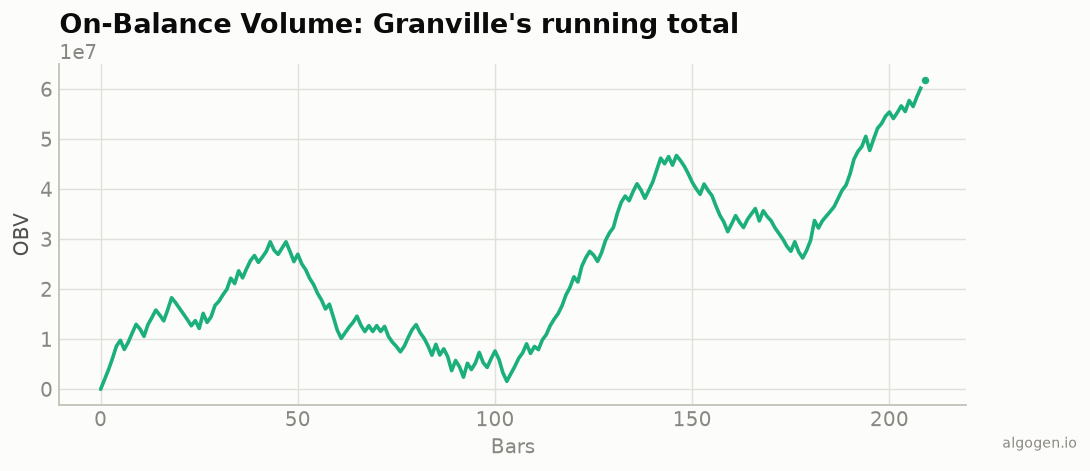
OBV was his tool for making that pressure visible. By keeping a simple running total — adding volume on up days, subtracting it on down days — he turned the messy stream of daily volume into a single line whose direction revealed whether money was flowing in or out. It was one of the earliest indicators to track the cumulative flow of volume, and its simplicity is a big part of why it survived.
The showman who moved markets
To understand why OBV spread, you have to understand Granville the phenomenon. He wrote The Granville Market Letter and became, in the late 1970s and early 1980s, arguably the most famous market forecaster in America. His seminars were legendary spectacles — he once appeared on stage in ways more befitting a rock concert than an investment talk, complete with theatrics, props, and showmanship that made him a celebrity.
More strikingly, his following was so large that his calls became self-fulfilling. When Granville told subscribers to “sell everything” in early 1981, the market dropped sharply on heavy volume the next day — a vivid, if uncomfortable, demonstration of his own thesis that volume drives price. He made dramatic, sometimes wildly wrong predictions over his career, but his influence on how traders think about volume is undeniable.
Why OBV endured past its creator
Granville’s forecasting record was famously uneven, and his flair invited plenty of skepticism. But OBV outlived the theatrics for the same reasons the other classics did: it’s simple, well-defined, and trivial to compute. There’s no parameter to argue about, no smoothing to tune — just a running sum with an up/down rule. When charting software arrived, OBV was one of the easiest indicators imaginable to program, and it became a standard volume study on every platform.
It also planted a durable idea: that volume flow deserves its own line, not just a histogram at the bottom of the chart. The whole family of cumulative volume-flow indicators — the Accumulation/Distribution line, Chaikin Money Flow, and others — descends from the basic move Granville made in 1963: accumulate volume with a sign attached and watch where it goes.
The criticism, in fairness
OBV isn’t above reproach, and the critiques are worth knowing. Because it adds the entire day’s volume regardless of whether price rose a penny or a fortune, it throws away the magnitude of each move — a flaw later volume indicators deliberately addressed. And “volume precedes price,” while a catchy slogan, is not a reliable law; plenty of divergences never pay off. Granville’s own forecasting record, full of bold and frequently wrong calls, is a cautionary tale about treating any single indicator (or guru) as gospel. But none of that sank OBV, because as a confirmation tool — a quick second opinion on whether volume backs a price move — it remains genuinely useful and costs nothing to compute.
Joseph Granville died in 2013, remembered as much for his spectacle as his substance. But every time a modern trader glances at an OBV line to check whether volume is confirming a breakout, they’re using a tool from that 1963 book — a tool that, like everything in this series, is just arithmetic you can rebuild yourself, as we do in the implementation posts.
This post is educational, not financial advice. Indicators describe the past; they don’t predict the future. Backtest anything before you risk real money on it.
Sources and further reading
- New Key to Stock Market Profits (Google Books)