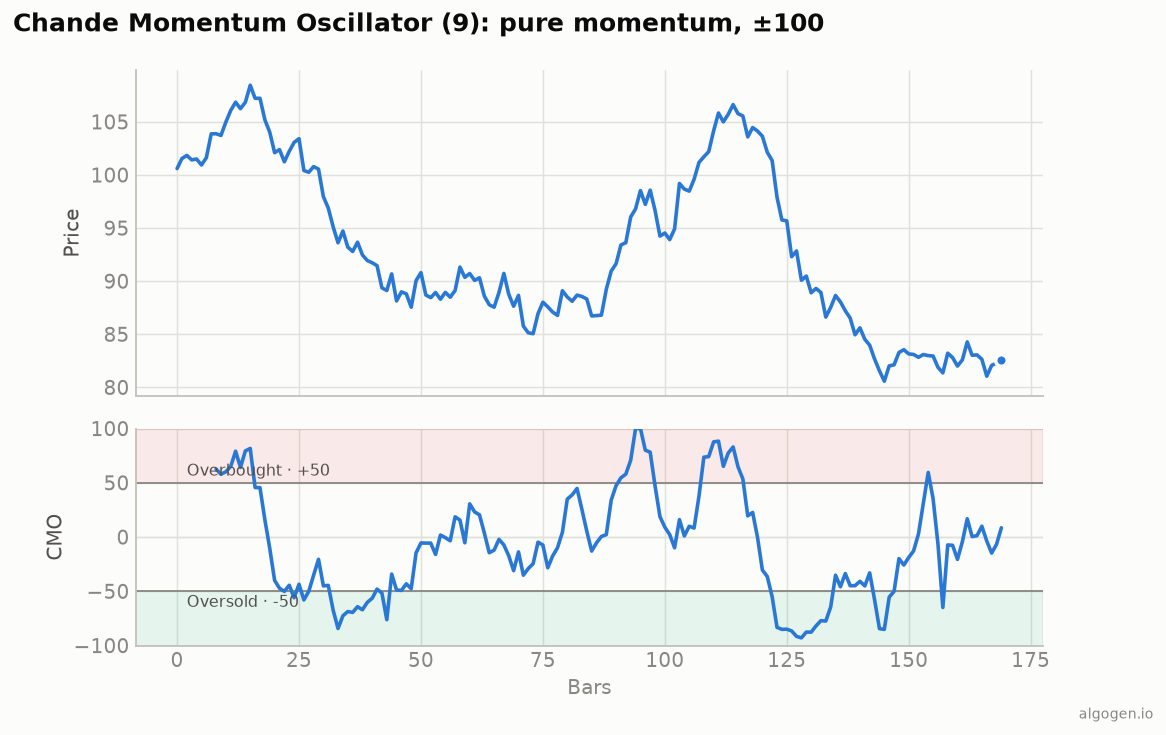
The Chande Momentum Oscillator (CMO) is what you get when you take the core idea behind RSI — compare up-moves to down-moves — and strip out the smoothing that makes RSI sluggish. The result is a faster, more responsive momentum gauge that swings across a symmetric ±100 scale. If you’ve ever wished RSI reacted quicker, the CMO is worth knowing.
The one-sentence job
The CMO measures net momentum by comparing the sum of recent up-moves to the sum of recent down-moves, as a percentage of total movement. All buying and no selling reads +100; all selling reads −100; balanced reads 0.
The formula
Over the last N bars (Chande’s default is 9):
1. For each bar, take the change from the previous close.
2. SU = sum of all the UP changes over N bars
3. SD = sum of the absolute value of all the DOWN changes over N bars
4. CMO = 100 × (SU − SD) / (SU + SD)
The numerator, SU − SD, is net momentum: positive when buyers dominated, negative when
sellers did. The denominator, SU + SD, is total movement, which normalizes the result
onto the −100 to +100 range regardless of the instrument’s price. Simple, symmetric, and
honest.
How it differs from RSI (the whole point)
RSI and CMO both compare up-moves to down-moves, but two design choices set the CMO apart:
- No Wilder smoothing. RSI runs its average gain and average loss through Wilder’s exponential smoothing. The CMO uses plain sums over the window — no smoothing at all. That makes it react faster and reach the extremes more often.
- It uses both up and down in the numerator. RSI’s formula effectively looks at the
ratio of average gain to average loss; the CMO puts
SU − SDdirectly on top. The effect is a cleaner measure of net directional pressure.
The practical upshot: the CMO is more responsive and more volatile than RSI. It gives earlier signals at the cost of more false ones — the classic speed-versus-noise trade-off.
How to read it
Overbought / oversold. Because it’s faster, the CMO uses wider thresholds than RSI: +50 for overbought and −50 for oversold are the common levels (some traders use ±40 or ±60). Above +50, buyers have been strongly in control; below −50, sellers.
Zero line. Crossing above zero means up-moves now outweigh down-moves over the window — a momentum flip. The zero cross is the CMO’s simplest trend-direction cue.
Divergence. As with any oscillator, price making a new high while the CMO makes a lower high warns that momentum is fading beneath the move.
Trend strength. Chande also intended the CMO as an input to adaptive systems — for example, feeding its absolute value into a variable-length moving average so the average speeds up when momentum is strong. That’s a more advanced use, but it’s why he built it.
Where it lies to you
- Faster means noisier. The lack of smoothing that makes the CMO responsive also makes it whipsaw in choppy markets. Wider thresholds (±50) exist for a reason.
- Extremes aren’t reversals. A CMO pinned near +100 signals a strong trend, not an imminent top. Fading it blindly is how you get run over.
- Short default is twitchy. The 9-period default is quick; bump it to 14 or 20 for smoother, less frequent signals.
- It’s momentum, not price. Like all oscillators, it can diverge from price for a long time before anything happens.
The CMO is a clean, symmetric momentum reading that trades RSI’s smoothness for speed. If you like RSI’s logic but find it slow, this is the tool to test.
Now go test it, don’t trust it
Does a CMO zero-cross, or a ±50 reversal, actually beat the equivalent RSI rule on your instrument? That’s a direct A/B test. Build both in AlgoGen. Then compute the CMO yourself in Python, MQL5, Pine Script, EasyLanguage, or NinjaScript.
This post is educational, not financial advice. Indicators describe the past; they don’t predict the future. Backtest anything before you risk real money on it.